
May 13, 2026
LED vs Halogen Landscape Lighting: Which Is Right for Your Cincinnati Home?
LED has won the landscape lighting market on most counts — but halogen still has two real use cases. Here’s the honest 2026 comparison for Cincinnati homeowners.
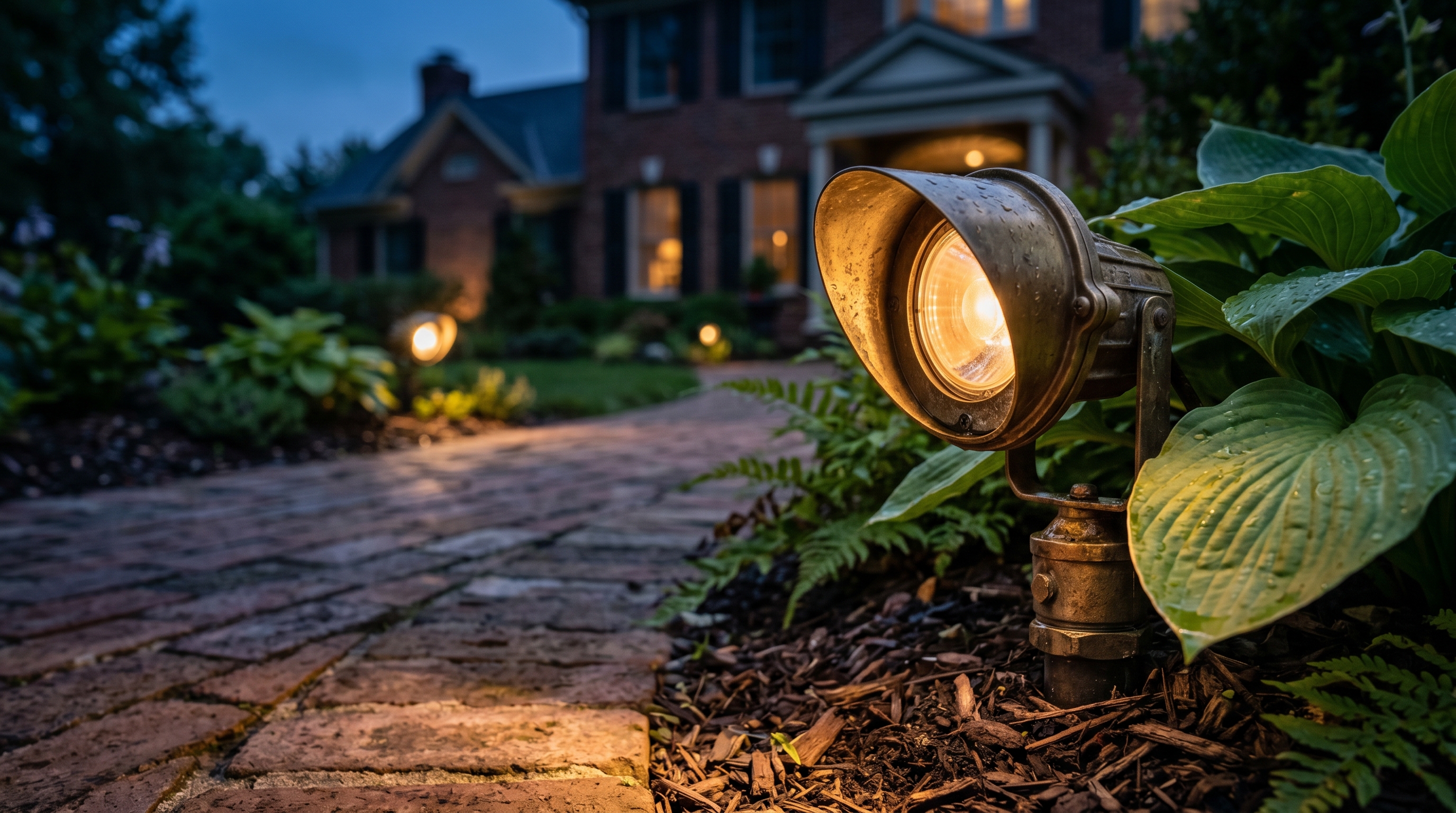
If you’re comparing LED vs halogen landscape lighting in 2026, LED wins on almost every measure: lifespan, energy cost, color quality (yes, color quality), and total cost of ownership over a 10-year horizon. Halogen still has two legitimate use cases. This post lays out the real differences, the Cincinnati-specific cost math, and how to decide — including how to keep your existing halogen fixtures and just swap the lamps.
What is the actual difference between LED and halogen landscape lighting?
The actual difference between LED and halogen landscape lighting is the light source inside the same fixture body. The brass or copper housing, the lens, the stake or mount — those are usually identical across LED and halogen products. The light-producing component is what changed:
- Halogen: A tungsten filament inside a quartz glass envelope, filled with halogen gas. The filament glows white-hot to produce light. ~90% of the energy comes out as heat, ~10% as visible light.
- LED: A semiconductor diode that emits light when current passes through. Much more efficient — ~40% of the energy becomes light, ~60% heat. No filament to burn out, no gas to leak.
For landscape lighting in Cincinnati, the standard fixture format is the MR16 — a 2-inch reflector lamp with a bi-pin base, used in path lights, uplights, and well lights. Both halogen and LED come in MR16 form factor, which is what makes the retrofit conversation easy: you can pull a halogen MR16 out of a brass fixture and drop an LED MR16 into the same socket.
How much does LED landscape lighting cost vs halogen in Cincinnati?
LED landscape lighting costs about 30% more up-front than halogen but 75% less over a 10-year horizon. Here are the real Cincinnati-market numbers we quote on installs in 2026:
- Halogen MR16 lamp: $5 – $9 per bulb, lasts ~2,000 hours (one to two years of nightly use)
- LED MR16 lamp (premium brand — FX Luminaire, Volt, Kichler): $25 – $45 per bulb, lasts 40,000 – 60,000 hours (15 to 25 years)
- Halogen fixture (complete) + lamp: $90 – $180 installed
- LED fixture (complete) + lamp: $130 – $250 installed
- 10-year electricity cost (24-fixture system, 6 hr/night): Halogen ~$420, LED ~$95 (Duke Energy Cincinnati residential rates)
- 10-year bulb replacement cost (24-fixture system): Halogen ~$960 (replace 24 bulbs 5x), LED ~$0 (one set lasts the decade)
Across a 24-fixture system in Greater Cincinnati, the 10-year total cost of LED is approximately $4,800 vs $6,200 for halogen — even with the higher up-front price. The break-even is about year four.
Do LED landscape lights look different than halogen?
LED landscape lights used to look noticeably different than halogen — bluer, harder, less inviting. That changed around 2018 with the arrival of high-CRI warm-white LEDs in 2700K and 3000K color temperatures. A modern premium MR16 LED in 2700K is, to a non-expert eye, indistinguishable from halogen at the same color temperature.
Two color-quality numbers matter for landscape lighting:
- Color temperature (Kelvin): Halogen is naturally ~2900K. LED landscape lighting comes in 2200K (very warm amber, “candle”), 2700K (warm white, halogen-equivalent), 3000K (slightly cooler warm white), and 4000K (cool white — avoid for residential). For Cincinnati homes we install 2700K on facade and path, 2200K on tree uplighting for the moonlight effect.
- Color Rendering Index (CRI): Halogen is 100 CRI by definition. Cheap LEDs are 80 CRI — brick reads slightly orange-flat, mulch reads muddy. Premium landscape LEDs are 90+ CRI — brick reads true red, foliage reads true green. Always spec 90+ CRI for residential install.
If a Cincinnati LED system looks “blue” or “hospital,” it’s either 4000K (wrong color temp for residential) or low-CRI (wrong spec for landscape work). Both are install mistakes, not LED limitations.
Are LEDs really brighter than halogen?
Per watt, LEDs are roughly 4 to 6 times brighter than halogen. But landscape lighting is rarely about absolute brightness — it’s about delivered lumens at the right beam angle. A 20W halogen MR16 puts out ~250 lumens at the lamp, but with the reflector inefficiency and lens losses, maybe 150 lumens hits the target. A 6W premium LED MR16 puts out ~480 lumens at the lamp, and with the better directional optics, maybe 380 lumens hits the target.
Practical effect on a Cincinnati install: with LED, we can use narrower beam angles (10° for facade uplighting on a 2-story colonial, 24° for spotlighting a tree) because the LED delivers more light into the same beam. With halogen, we had to use wider beams (38° was the workhorse) to compensate for losses — which meant more glare and more light trespass onto neighboring properties. Cincinnati municipalities increasingly enforce light-trespass codes; LED’s tighter beam control is a real compliance advantage.
How long does LED landscape lighting last vs halogen?
Premium LED landscape lighting lasts 15 to 25 years of nightly use. Halogen lasts 1 to 2 years. The 20x difference is the single biggest reason LED has taken over the market.
In practice on a Cincinnati system, that means:
- Halogen 24-fixture system: Replace every bulb every ~18 months. Across 15 years, that’s 10 bulb changes per fixture, ~240 bulb changes total. A $9 bulb plus a service call to replace it (or an hour of your own time) every 18 months.
- LED 24-fixture system: Replace every bulb at ~year 17. Across 15 years, zero scheduled bulb changes. One eventual relamp event in the late 2030s.
The other lifespan advantage: LEDs fail gracefully (gradual dim over months) where halogens fail abruptly (working one night, dead the next). The graceful-fail mode means you can schedule a relamp visit rather than reacting to a dead fixture.
Can I retrofit my existing halogen landscape lighting to LED?
You can retrofit almost every halogen landscape lighting system in Cincinnati to LED, and in most cases the retrofit pays for itself in two to three years through transformer relief and bulb savings. The retrofit is mechanically simple:
- Pull the halogen MR16 lamp from each fixture. Bi-pin base, twists out.
- Insert an LED MR16 of matching color temperature (2700K) and beam angle. Same physical socket.
- Verify load on the transformer. Total wattage drops 75% — a 480W halogen load becomes a ~120W LED load. If the transformer is already old, this is the time to right-size it (most installers oversized for halogen, then under-loaded transformers shortened their own life).
The retrofit cost on a typical Cincinnati 24-fixture install: $900 to $1,400, including premium-brand LED MR16s and a service visit to verify transformer load and clean every connection. Compare that to replacing the whole system at $8,000 to $18,000 — the retrofit is usually the obvious choice if the fixture bodies and main wire run are sound.
When does halogen landscape lighting still make sense?
Halogen landscape lighting still makes sense in two scenarios, and only two:
- Color-critical accent on a single feature: Halogen’s 100 CRI and continuous spectrum is still slightly better for showing off natural stone, weathered copper, or art installations under landscape lighting. A handful of high-end estate jobs in Indian Hill and Hyde Park still spec halogen on one or two feature fixtures for this reason.
- Properties without consistent dusk-to-dawn use: If lights are only on for special events 20 nights a year, halogen’s 2,000-hour lifespan is enough — and the lower up-front cost (~$5 vs $30 per bulb) wins. This is mostly event-venue territory, not residential.
For 95% of Cincinnati residential installs in 2026, LED is the right answer. The remaining cases are niche.
How to decide for your Cincinnati home
If you’re installing a new landscape lighting system in 2026, spec LED — 2700K, 90+ CRI, premium-brand MR16s in brass or copper fixtures. The math doesn’t favor halogen for new installs anymore.
If you have an existing halogen system that’s still working, plan a retrofit when you next have a bulb out. Pulling 24 halogens out at once and dropping LEDs in is cleaner than doing them one at a time as they fail.
If you have an old system that’s mostly dead, you have a bigger decision — see our repair vs replacement guide for the cost math on rescuing the wiring vs starting over.
We design and install both new LED systems and LED retrofits across Maineville, Mason, West Chester, Loveland, Montgomery, Indian Hill, Hyde Park, and Anderson Township. Call (513) 828-8501 or request a free estimate on the contact page.
Want a property like the ones in this post?
Free on-site consultation across Greater Cincinnati.
Schedule a Free Estimate