
May 13, 2026
Why Your Landscape Lights Stopped Working — And Why Most Cincinnati Companies Won't Fix Them
Most Cincinnati landscape lighting companies won’t touch a system they didn’t install. Here’s why outdoor lights fail, what repairs actually cost, and how to tell when a fix is worth it.
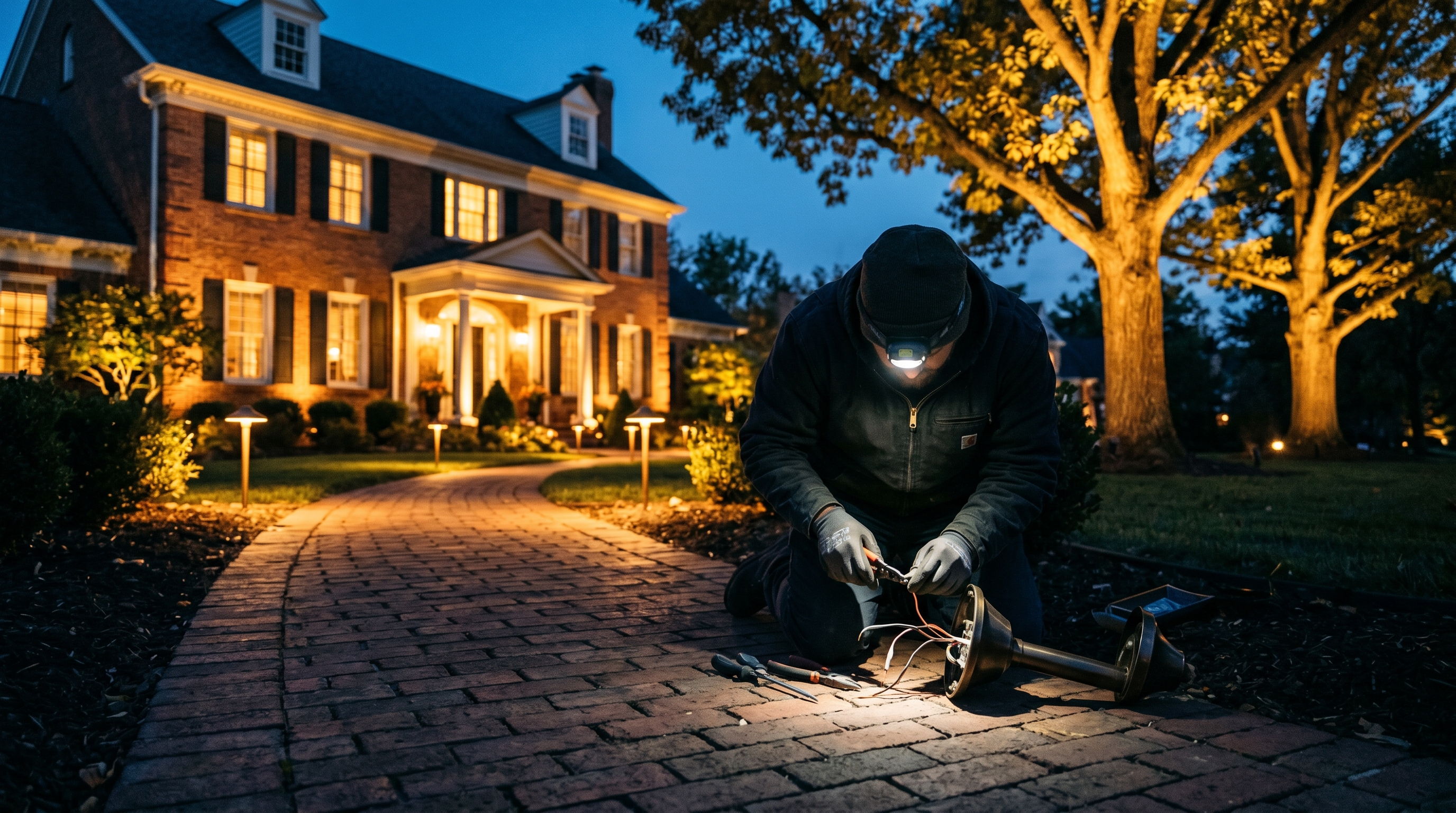
You spent five-figures on an outdoor lighting system five years ago. Now half the fixtures are out, the transformer hums, and the company that installed it has either ghosted you, gone out of business, or politely told you they don’t service systems older than three years. If you’ve called around in Greater Cincinnati, you’ve probably heard the same answer: we only work on systems we installed. This post is about why that happens, what landscape lighting actually fails on, and how to get your system fixed without re-buying the whole thing.
Why do landscape lights stop working?
Landscape lights stop working for five reasons, and four of them are not the bulbs. We service systems across Greater Cincinnati every week, and the failure pattern is the same:
- Transformer failure (the most common): The transformer is the box on the side of the house that drops 120V mains down to 12V for the fixtures. They’re rated for a ten-year service life, but a transformer running near 100% of its VA capacity will burn out in three to five. The bigger problem — most installers undersize the transformer to win the bid.
- Buried wire corrosion: Cincinnati clay holds moisture against direct-burial cable. After five to eight winters of freeze-thaw, the copper inside the jacket oxidizes and the voltage drop kills fixtures on the back half of the run. The lights closest to the transformer stay bright; the lights at the end of the wire go dim, then dark.
- Wire-nut failure at fixture junctions: Cheap installers use plastic twist-on wire nuts inside fixture stems. Water gets in, the nut greens up, the circuit opens. We see this on systems where every fourth fixture is out in a random pattern.
- Fixture lens degradation: UV breaks down acrylic and inexpensive PMMA lenses. The bulb is fine, the wiring is fine — the lens has just gone cloudy or yellow enough to cut output by 60%.
- The bulbs themselves: If the fixture is original halogen MR16 and it’s been five years, it’s probably the lamp. But this is the easy case — you can usually swap the bulb yourself and confirm before calling anyone.
Most homeowners assume the bulbs first. Most installers assume the transformer first. The honest answer is: you can’t know without a meter on the transformer output and a voltage check at three or four fixtures along the run.
What does it cost to repair landscape lighting in Cincinnati?
A landscape lighting repair in the Cincinnati metro typically runs between $350 and $4,000 in 2026, depending on what’s actually failing. Here are the realistic price bands we see on repair calls across Mason, Loveland, Montgomery, Indian Hill, Hyde Park, and Anderson Township:
- Diagnostic + minor fix (loose connection, single bulb, simple junction repair): $350 – $650 flat
- Transformer replacement (typical 300VA – 600VA unit, including the unit): $1,200 – $2,400
- Partial re-wire on a single run + connector cleanup: $800 – $1,800
- Whole-system rescue (corroded wire, mixed failures, 25+ fixtures): $2,500 – $4,000
- Full re-install (when the bones are too far gone): $6,000 and up — treat as new install at that point
If a repair quote comes in below $300 for anything beyond a bulb swap, ask what the diagnostic actually covers. There’s a real cost to driving out, putting a meter on each leg of the system, and writing up an honest report — and any company doing that work properly has to charge for it.
Why won’t most Cincinnati landscape lighting companies repair existing systems?
Most Cincinnati landscape lighting companies won’t repair existing systems because the math is bad for them — not because the work is hard. A new install is a $6,000 – $25,000 ticket. A repair call is a $400 – $2,000 ticket and takes the same drive time, the same crew, and twice the diagnostic effort. The franchise outfits and the design-focused installers chase the bigger ticket and leave the repair work uncovered. That’s how the market got the way it is.
The other reason is liability. If we open up someone else’s wire splices and the system fails again two months later because of another bad splice we didn’t touch, the customer is — reasonably — going to be upset. A lot of companies just don’t want the exposure. We take the opposite position: we’ll diagnose the full system, give you a written scope of what we’d fix, and quote the rest separately so the boundary of our work is crystal clear before we start.
Can old halogen systems be repaired or do I have to replace?
Old halogen systems can almost always be repaired, and in most Cincinnati cases the wiring and transformer are the parts worth saving. The fixtures themselves — the brass or copper bodies — have a 20 to 40 year service life if they’re well-made. What fails is the lamp, the lens gasket, and the socket. All three are replaceable, and the brass body can usually be re-lamped with a screw-in LED MR16 retrofit that drops power draw 75% and quadruples bulb life.
The retrofit math is good: a $30 LED MR16 replaces a $7 halogen MR16 that pulls 20W. Across 24 fixtures, that’s the difference between 480W and 120W of transformer load — which means a transformer running at 80% capacity is suddenly at 20% capacity, and its remaining life triples. So the right repair on an old halogen system is often: keep the brass, keep the wire, swap every lamp to LED, replace the transformer with a properly-sized unit, and clean every connection.
How do you diagnose a failing landscape lighting transformer?
A failing landscape lighting transformer shows three diagnostic signs, in order of urgency:
- Output voltage below 11V on the 12V tap when measured under load. A healthy transformer at full load should read 11.5V to 12.5V. Below 11V means either the transformer is failing or the wiring downstream is undersized.
- Audible hum or buzz from the transformer body. Toroidal-core transformers should run almost silent. A buzz means the laminations are loose or the magnetic field is degrading.
- Hot to the touch. The housing should be warm in summer, not hot. If you can’t hold your hand on it for ten seconds, the transformer is over-loaded or its cooling has failed.
You can check the first two yourself with a $40 multimeter from any hardware store. If you see any of these signs, get a professional diagnostic before the unit fails completely — replacement during a controlled service call is a third of the cost of an emergency replacement after the unit smokes itself out.
What should I do before calling for a landscape lighting repair?
Before you call any landscape lighting repair company in Cincinnati, do these four things to save yourself time and money:
- Count what’s out vs. what’s working. Walk the property at dusk with a flashlight and count: total fixtures, fixtures completely out, fixtures dim, fixtures flickering. Write it down. A pattern (e.g., “all six lights past the driveway are out”) tells the technician exactly where to start.
- Check the transformer. Find the box on the side of the house, open it, look for a tripped photocell or timer, listen for buzz, feel for heat. Document what you see.
- Swap one bulb. Pull a working bulb from a working fixture, put it in a dead fixture. If the dead fixture lights up, you have a bulb problem. If it stays dark, the problem is upstream — wire, connector, or transformer.
- Find the original install records if you have them. Fixture brand, transformer size, install date, original wire gauge. Even a paid invoice from five years ago saves us an hour on the diagnostic.
This is the same checklist we run when we get on-site, just done in advance. Customers who do this before the call save $100 to $200 on the diagnostic because we can come straight in with the right parts.
When is a landscape lighting repair not worth it?
A landscape lighting repair is not worth it when the cumulative repair cost exceeds about 60% of replacement, or when more than two of the four major sub-systems (transformer, main wire run, fixture bodies, connectors) are at end-of-life. The threshold is roughly: if we’d have to replace the transformer AND re-wire AND swap most fixtures, you’re paying for a new system in installments without getting a new-system warranty. At that point we’ll tell you honestly — this is a 60-year-old patient and the engine block is cracked.
The lines we use as installers: a 12-year-old system with intact brass fixtures and a single transformer failure is a clear repair (save $4,000+ vs. replacement). A 20-year-old system with corroded wire, mixed brands, and three failed transformers over its life is a clear replacement — even if the original bones look fine, the install methods of the 2000s assumed cheaper wire and worse connectors. The math has shifted.
How to get your outdoor lighting fixed across Greater Cincinnati
If your landscape lighting has stopped working, we cover Maineville, Mason, West Chester, Loveland, Montgomery, Indian Hill, Hyde Park, and Anderson Township for repair calls — including on systems we didn’t install. Our diagnostic visit gives you a written report of what’s failing, what it costs to fix, and what we’d recommend leaving alone. No pressure to replace if a repair will do.
Call (513) 828-8501 or request a quote on the contact page. We’ll usually have an opening within the week.
Want a property like the ones in this post?
Free on-site consultation across Greater Cincinnati.
Schedule a Free Estimate